

РОLIMUN La-Sоtа+Н120
Lyophilizate

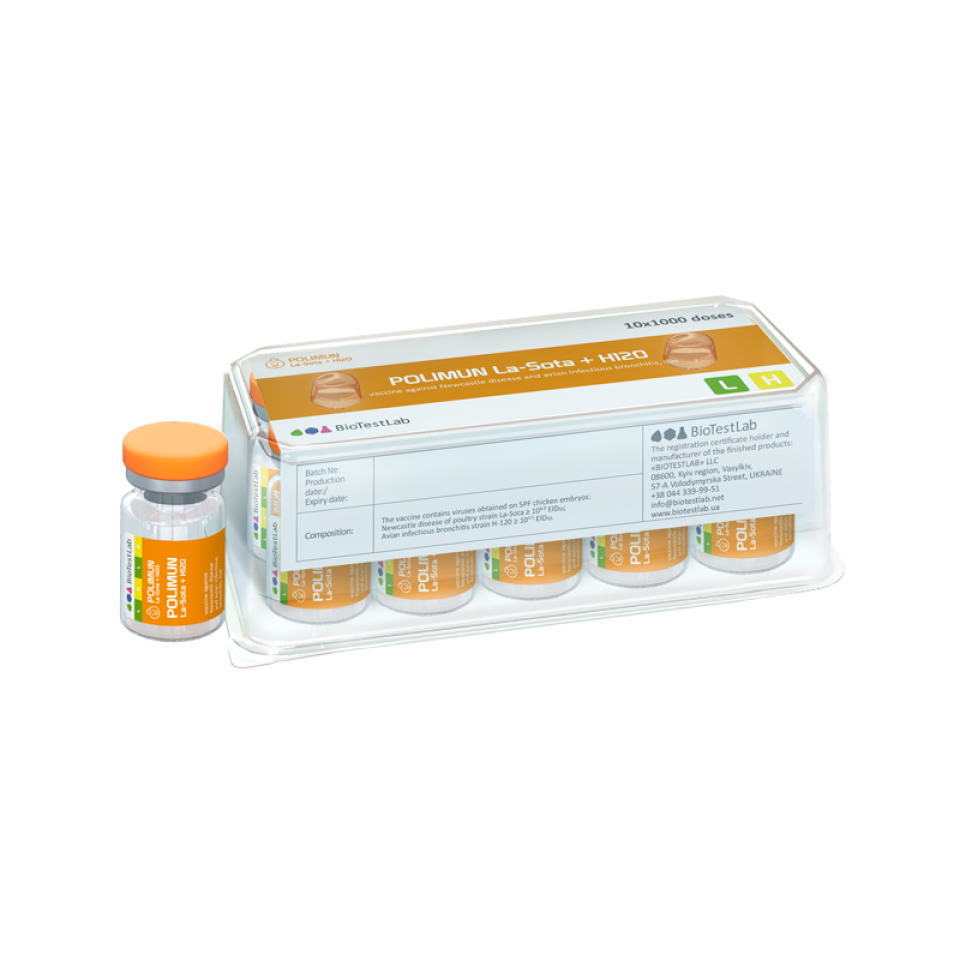
Composition
Active substances per dose:
The vaccine contains chicken embryo-derived viruses produced on SPF chicken embryos:
Newcastle disease virus, La Sota strain, ≥ 106.0 EID50; Infectious bronchitis virus, H-120 strain, ≥ 103.5 EID50.
Pharmaceutical form
Lyophilizate.
Immunobiological properties
The vaccine provides protection for vaccinated poultry against Newcastle disease and infectious bronchitis in chickens.
The intensity and duration of immunity depend on the clinical condition and housing conditions of the poultry before and after vaccination.
It does not possess therapeutic properties.
Bird species
Chickens.
Indications for use
Prevention of Newcastle disease and infectious bronchitis in chickens.
Special instructions for use during laying period
No contraindications.
Administration and dosage
The vaccine is administered to poultry using one of the following methods: drinking water, intranasally, or by coarse spray. Drinking water is used for reconstitution and dilution.
The optimal vaccination (revaccination) schedule for poultry in farms is determined based on the epizootic situation and the intensity of immunity.
The effectiveness of immunization against Newcastle disease in vaccinated poultry is determined by the results of AGID in blood serum, expressed as a percentage. Blood serum samples are collected 2-3 weeks after vaccination.
Group immunity is considered to be formed when 80% or more of the tested sera show the following antibody titers after vaccination:
In chicks up to one month of age: 1:8 and above; In chicks from 30 to 60 days of age: 1:8 - 1:16 (dominant) and above; In young birds from 60 to 140 days of age: 1:16 - 1:32 (dominant) and above; In adult birds: 1:32 - 1:64 (dominant) and above.
If the effectiveness of immunization is less than 80%, revaccination of the poultry is required.
The initial vaccination of poultry is recommended at 15-21 days of age. After a single administration, the vaccine induces an immune response lasting approximately 6 weeks.
In regions affected by Newcastle disease, the vaccine can be used intranasally or by coarse spray for vaccination of day-old chicks, with subsequent revaccination at 18-21 days of age.
Drinking water method
On the day of vaccination, the contents of the vaccine vials are dissolved in clean room temperature drinking water. The vaccine is diluted in a way that one vaccine dose for one bird is contained in the specified volume of drinking water one day before vaccination.
Drinkers should be thoroughly cleaned before vaccination without adding disinfectant solutions.
For better vaccination performance, it is recommended to use an indicator dye such as "INDIGO MAX" or other similar dyes of equivalent quality.
Intranasal method
The vaccine is dissolved in room temperature drinking water at a rate of 10 ml for 100 doses, 100 ml for 1000 doses, 250 ml for 2500 doses, and 500 ml for 5000 doses. Two drops are instilled into the nostril of birds of all age groups, while the second nostril is closed with a finger. If the nasal airways are not permeable, the same volume of vaccine should be instilled into the bird's eye.
Coarse spray method
The vaccine is dissolved in chlorine- and iron-free drinking water at a rate of 250-500 ml for chicks up to one month of age and 500-1000 ml for older birds for 1000 doses. Vaccination is carried out using a sprayer that maintains constant pressure and has a calibrated nozzle. The vaccine is sprayed from
Symptoms of overdose: In case of a 10-fold overdose, the vaccine does not cause Newcastle disease or infectious bronchitis in chickens.
Emergency measures: There are no specific emergency measures required in case of overdose with this vaccine. However, it is always recommended to consult with a veterinarian or healthcare professional for guidance.
Waiting period: There is no waiting period required after vaccination with this vaccine. The poultry can be used for consumption or production immediately after vaccination.
Storage and transportation conditions: The vaccine should be stored in a dark place at a temperature between 2°C and 8°C. Freezing and storing the vaccine at a temperature of -20°C for the duration of its shelf life does not have a negative impact on its quality.
Temperature fluctuations within the range of -5°C to +14°C during transportation are acceptable for up to 21 days. Such temperature fluctuations do not adversely affect the quality of the vaccine.
It's important to follow the storage and transportation instructions to ensure the vaccine remains effective and maintains its quality.