

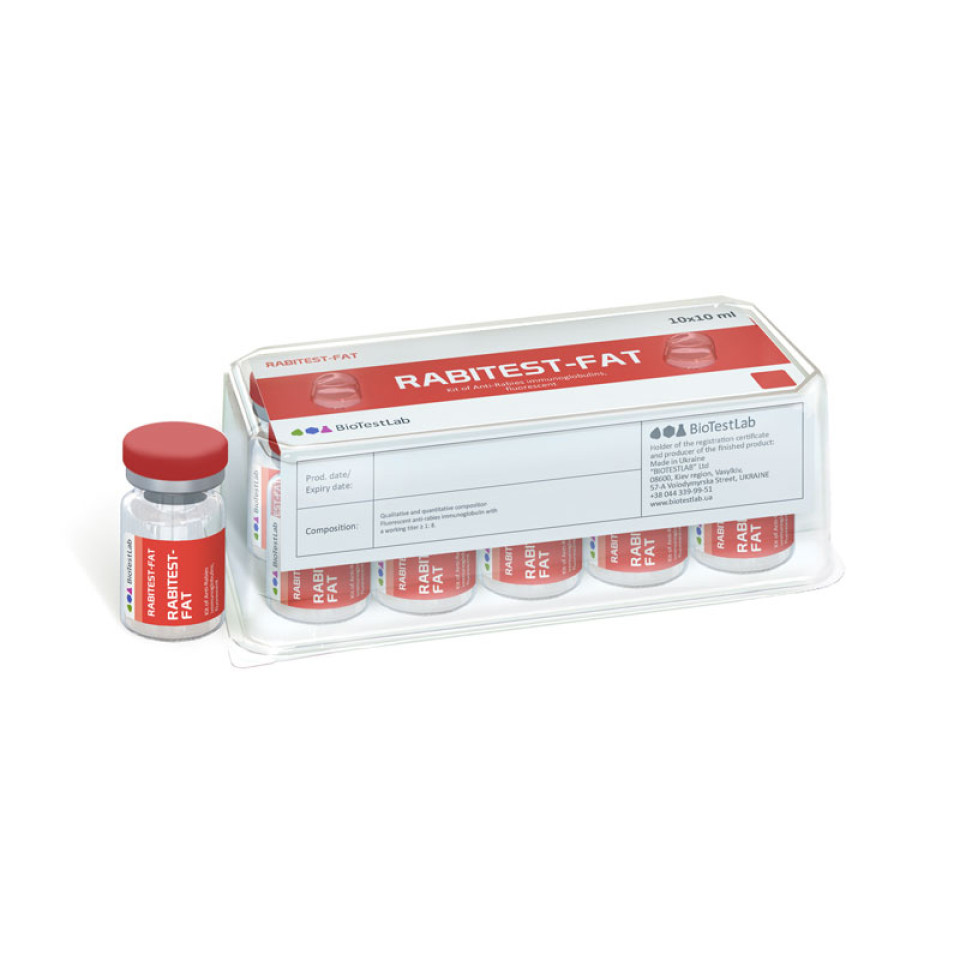
RABITEST-FAT


Composition
Qualitative and quantitative composition
Fluorescent anti-rabies immunoglobulin with a working titer 2 1: 8.
Pharmaceutical form
Lyophilisate.
Immunobiological effect
The test-kit is used to diagnose rabies in vitro.
Animal species
Globulins are intended to detect rabies virus antigen in the pathological material of all animal species.
Indication
The kit is used to diagnose rabies in immunofluorescence assay (IFA).
IMMUNOFLUORESCENCE ASSAY PROCEDURE
Materials:
Luminescent microscope, glass slides, measuring pipettes 1; 2; 5; 10 ml, graduated laboratory flasks, bacteriological dishes, dimethyl phthalate, acetone chemically pure or pure for analysis, phosphate. buffered saline (PBS) pH 7.2-7.4; "RABITEST-FAT" - fluorescent anti-rabies globulin; positive and negative controls
Preparation of phosphate-buffered saline pH 7.2-7.4:
PBS is prepared according to the following recipe: disodium phosphate (anhydrous) - 1.25 g, monosubstituted potassium phosphate - 0.272 g, sodium chloride - 8.5 g, distilled water - up to 1000 cm'.
Preparation of the test material specimens:
To study, the smears or imprints are prepared from different parts of the fresh or fresh-frozen (pre-thawed) brain of the animal (ammonium horns, cerebellum, medulla oblongata, cortex of the large hemispheres) using pre-degreased slides. At least two smears or imprints are prepared from each part of the brain.
The brain specimens of animals in the decompose stage, preserved with glycerin, fixed with methyl or ethyl alcohol, formalin, or other substances that contribute to the occurrence of nonspecific fluorescence cannot be used to test.
To make smears, pieces of the brain weighing 0.5-1.0 g from the above-mentioned parts of the brain are ground in a mortar until a homogeneous mass is formed, from which thin smears are subsequently prepared on slides.
To make imprints: using scissors cut out pieces of tissue with a size of 5 mm2 to 10 mm2 from the indicated parts of the brain, then place them on filter paper folded in 4-6 layers to remove excess moisture. The cut surface is touched 3-4 times with a slide, barely pressing on it, until a thin imprint is obtained on the slide.
To make the negative controls, the smears or imprints from the brains of healthy mice (non-infected and unvaccinated against rabies) are used. Positive control samples are prepared from the brains of mice inoculated with the CVS reference strain of rabies virus, or from beforehand tested positive material. The brains of inoculated mice are selected at the agony stage.
After preparation, the smears or imprints are dried in air at room temperature and then fixed by acetone at a temperature of minus 20°C for 30-60 minutes.
Immunofluorescence assay:
The lyophilized "RABITEST-FAT" - fluorescent anti-rabies globulin is reconstituted with distilled water to the initial volume indicated on the label. Then, prepare a working dilution of globulin, indicated on the label, by adding the required volume of 0.01 M PBS
For the study, smears or imprints are used, which are coated by working dilution of «RABITEST-FAT», fluorescent anti-rabies globulin. The globulin solution is spread out evenly over the entire surface of the prepared specimen, using a pipette in an amount of 0.1 + 0.01 cm° per specimen.
The prepared specimens are then placed in a humid chamber and kept in a thermostat for 30 minutes at a temperature of 37°C. At the same time, control samples are stained. After 30 minutes, the fluorescent globulins are washed off with distilled water; the slides with smears are washed with PBS (pH 7.2-7.4) three times for 10 minutes, changing PBS
After this, the stained specimens are rinsed with distilled water, dried in air, and examined under a fluorescent microscope (in immersion) in a blue-green spectrum. For this, non-fluorescent oil or glycerin for fluorescence microscopy is used.
The diagnosis of rabies is considered to be positive if at least 10 typical fluorescent granules were detected in several fields of view of the microscope in the absence of specific luminescence in the negative controls and the presence of typical granules in the positive controls.
Using during pregnancy, lactation, egg-laying
Does not exist.
Doses and routes of administration
It is used for in vitro diagnostics in accordance with the leaflet.
Special precautions
Only vaccinated personnel are allowed to carry out diagnostics for rabies.
Withdrawal period
Does not exist.
Forms of incompatibility
Not detected.
Shelf life
24 months. The test-kit is stored in a dark place at a temperature of 2° to 8°C.
Storage conditions
After reconstitution, fluorescent globulin can be stored at 2° to 8°C for no more than 24 hours, or as frozen at a temperature not exceeding minus 12°C for up to 14 days. Do not expose to light. Keep out the reach of children.