

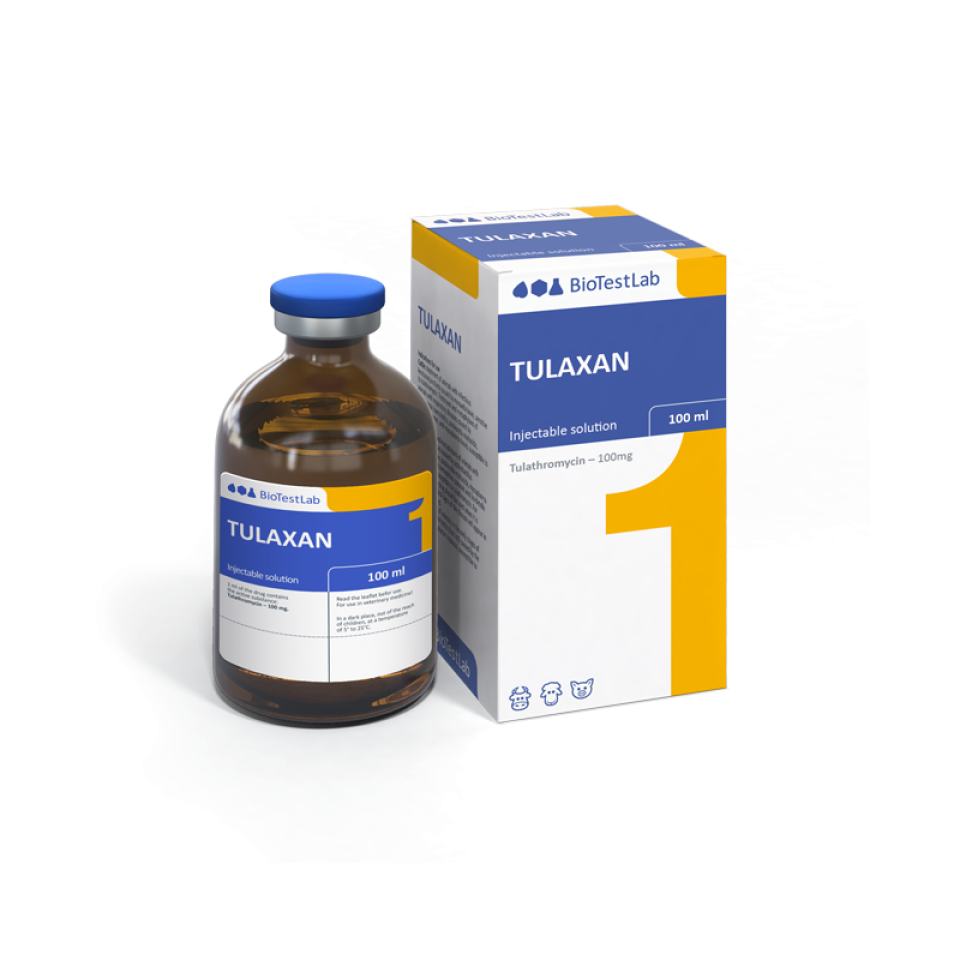
TULAXAN
Injectable solution


Description
Transparent, colorless or slightly yellowish solution.
Composition
1 ml of the drug contains the active substance:
tulathromycin – 100 mg.
Excipients: monothioglycerol, propylene glycol, citric acid, hydrochloric acid, sodium hydroxide, water for injection.
4. Pharmacological properties
ATC vet classification code QJ01 – antibacterial veterinary drugs for systemic use, macrolides. QJ01FA94 – Tulathromycin.
Tulathromycin is a semi-synthetic antibiotic from the macrolide group. It differs from many other macrolides in its prolonged action (due in part to its three amino groups), and its chemical subclass name is triamilide.
Tulathromycin acts bacteriostatically. Due to the ability of tulathromycin to selectively bind to bacterial ribosomal RNA and stimulate the dissociation of peptidyl-tRNA from the ribosome during translocation, the biosynthesis of proteins important for bacteria is inhibited.
Tulathromycin is active in vitro against: Gram-negative (Mannheimia haemolytica, Pasteurella multocida, Histophilus somni, Mycoplasma bovis, Actinobacillus pleuropneumoniae, Haemophilus parasuis and Bordetella bronchiseptica) and Gram-positive (Mycoplasma hyopneumoniae) bacteria, which most often cause respiratory diseases in cattle and pigs. Tulathromycin is active in vitro against Dihchelobacter nodosus and Moraxella bovis.
In cattle, the pharmacokinetic profile of tulathromycin after a single subcutaneous dose of 2.5 mg/kg body weight is characterized by rapid and intense absorption, good distribution and slow elimination. The maximum concentration of tulathromycin (Cmax) in blood plasma is approximately 0.5 μg/ml; this concentration was reached approximately 30 minutes after administration (Tmax). Concentrations of tulathromycin in lung homogenate were significantly higher than in plasma. Peak concentrations are followed by a slow decline in systemic exposure with a half-life (t1/2) of 90 hours in plasma. Binding to plasma proteins is about 40%. The bioavailability of tulathromycin after subcutaneous administration to cattle was approximately 90%.
In pigs, the pharmacokinetic profile of tulathromycin after a single intramuscular dose of 2.5 mg/kg body weight is also characterized by rapid and intense absorption, good distribution and slow elimination.
The maximum concentration of tulathromycin (Cmax) in plasma is approximately 0.6 μg/ml 30 minutes after administration (Tmax). Concentrations of tulathromycin in lung homogenate are significantly higher than in plasma. There is evidence of significant accumulation of tulathromycin in neutrophils and alveolar macrophages. Peak concentrations are followed by a slow decline in systemic exposure with a mean half-life (t1/2) of approximately 91 hours. Approximately 40% of tulathromycin is bound to plasma proteins. The bioavailability of tulathromycin after intramuscular administration to pigs is about 88%.
In sheep, after a single intramuscular dose of 2.5 mg/kg body weight, the maximum concentration of tulathromycin (Cmax) in plasma was about 1.19 μg/ml approximately 15 minutes after administration (Tmax), and the half-life (t1/2) was 69.7 hours. Binding to blood plasma proteins is approximately 60-75%. The bioavailability of tulathromycin after intramuscular administration to sheep is 100%.
Indications for use
Cattle: treatment of animals with infectious keratoconjunctivitis caused by Moraxella bovis, sensitive to tulathromycin. Treatment and metaphylaxis of animals with respiratory diseases caused by Mannheimia haemolytica, Pasteurella multocida, Histophilus somni, and Mycoplasma bovis, susceptible to tulathromycin.
Pigs: treatment and metaphylaxis of animals with respiratory diseases caused by Actinobacillus pleuropneumoniae, Pasteurella multocida, Mycoplasma hyopneumoniae, Haemophilus parasuis and Bordetella bronchiseptica, susceptible to tulathromycin. For metaphylaxis, the drug should be used when it is expected that clinical signs of the disease will appear in pigs within 2-3 days.
Sheep: treatment of animals in the early stages of infectious pododermatitis (foot rot) caused by the bacterium Dichelobacter nodosus, susceptible to tulathromycin.
Routes of administration and dosage
Cattle: subcutaneously at a dose of 1 ml of the drug per 40 kg of body weight (2.5 mg of tulathromycin per 1 kg of body weight) once. When treating animals weighing more than 300 kg, the dose is divided so that no more than 7.5 ml of the drug is injected into one place.
Pigs: intramuscularly into the neck area at a dose of 1 ml of the drug per 40 kg of body weight (2.5 mg of tulathromycin per 1 kg of body weight) once. When treating animals weighing more than 80 kg, the dose is divided so that no more than 2 ml of the drug is injected into one place.
Sheep: intramuscularly in the neck area at a dose of 1 ml of the drug per 40 kg of body weight (2.5 mg of tulathromycin per 1 kg of animal body weight) once.
For any respiratory disease, it is recommended that animals be treated in the early stages of the disease and the response to treatment assessed within 48 hours after injection. If clinical signs of respiratory disease persist or worsen, or a relapse occurs, treatment should be modified using a different antibiotic, and treatment should be continued until clinical signs resolve.
To ensure the correct dosage, it is necessary to accurately determine the animal's body weight to avoid overdosing or underdosing. For multiple administrations, it is recommended to use a multi-dose injector with an aspiration needle to avoid repeated puncture of the vial stopper.
Contraindications
Do not use in case of hypersensitivity to tulathromycin or other macrolides, or to any of the excipients.
Do not use the drug simultaneously with other macrolides and lincosamides.
Do not use in lactating cows whose milk is intended for human consumption.
Do not use in pregnant cows 2 months before calving if it is planned to obtain milk from them for human consumption.
Precautions
Side effects
Subcutaneous administration of the drug to cattle can often cause pain reactions and local swelling at the injection sites, which can last up to 30 days.
No such reactions were observed in pigs and sheep after intramuscular injection. Pathomorphological reactions at the injection site (including reversible changes such as congestion, edema, fibrosis and bleeding) are often observed within 30 days after injection in cattle and pigs.
In sheep, after intramuscular injection, temporary signs of discomfort (head shaking, itching at the injection site, walking backwards) are often observed. These signs disappear within a few minutes.
Special precautions for use
The use of the drug should be based on the results of a study of the antimicrobial sensitivity of bacteria isolated from a sick animal. If this is not possible, therapy should be based on regional, farmer epidemiological information on the susceptibility of the target bacteria. Official policies regarding the use of antibacterial agents should be considered. Use of the drug contrary to the information leaflet or summary of product characteristics may increase the prevalence of bacteria resistant to tulathromycin and reduce the effectiveness of treatment with other macrolides, lincosamides, or group B streptomycins due to the possibility of cross-resistance.
Use during pregnancy and lactation
The safety of using a veterinary drug during pregnancy and lactation of animals has not been established.
The use of the drug during pregnancy or lactation should be based on a benefit/risk assessment by the responsible veterinarian in each specific case.
Interaction with other drugs and other forms of interaction
When used simultaneously with other macrolides and lincosamides, cross-resistance may develop.
Withdrawal period
Slaughter of animals for meat is permitted 22 days (cattle), 13 days (pigs), and 16 days (sheep) after the last use of the drug. Meat received before the specified period is disposed of or fed to unproductive animals, depending on the conclusion of the veterinarian.
Do not administer the drug to animals whose milk is intended for human consumption.
Do not use in pregnant animals whose milk is intended for human consumption, 2 months before the expected calving.
Special warnings
If tulathromycin gets into the eyes, it causes irritation, so rinse them immediately with running water.
Sensitivity may occur if tulathromycin comes into contact with the skin, so wash the skin immediately with soap and water.
Wash your hands after contact with the drug.
In case of accidental administration to a person, immediately seek the advice of a doctor, providing him with these instructions for review.
Package
Glass bottles closed with rubber stoppers and aluminum caps, 10, 50, and 100 ml.
Storage conditions
Shelf life
24 months.
In a dark place, out of the reach of children, at a temperature of 5° to 25°С.
After drawing the first dose, the drug must be used within 28 days, provided that the drug is stored in a dry, dark place at a temperature of 5°C to 25°C.
For use in veterinary medicine!